


Game of Life by Rob MacWolf and Alex Vance
Updated: Sep 7
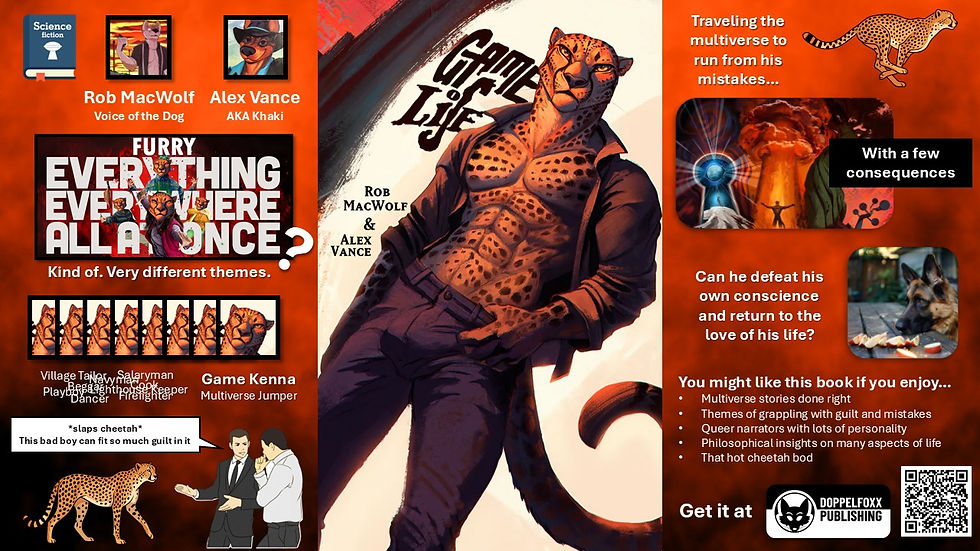
Topics: Gay, Multiverse
Genre: Sci-Fi
Age Rating: 18+ for semi-explicit sexual content
Available in Print, eBook, and Audiobook
You may like this book if you enjoy:
Multiverse stories done right
Themes of grappling with guilt and mistakes
Queer narrators with lots of personality
Philosophical insights on many aspects of life
That hot cheetah bod
Review Summary
I have read Game of Life twice, because when I finished listening to the audiobook, I enjoyed it so much that I immediately went back to page one and read the book again in print. Needless to say, this book has a lot to love. Its main character, Game Kenna, is theatrical, insightful, and endlessly entertaining, with a fantastic narrative voice that I found incredibly endearing. The multiverse element of the story is handled brilliantly, not only because the multiverse here is unlike other multiverses in media, but because it's crucial to the plot and themes presented. Plus this book has some great philosophical insights about the titular game of life, and I think readers will find a lot to take away with them after reading. This is the perfect book for anyone who wants to see furry literature work its magic.
Full Review
Game of Life is a hard book to give a synopsis of. It doesn't even have a synopsis on the back cover, opting instead to cover it with a mesmerizing collage of striking imagery that perhaps explains the book better than any synopsis ever could. Regardless, I'll give a somewhat traditional synopsis a go.
Game of Life follows Game Kenna, a beautiful bisexual cheetah (though he leans gay) who is quite literally a man of many lives. He can jump across infinite worlds and infinite versions of himself with ease, sometimes without even noticing he's done so. But as he continues to fall through the multiverse, his lives are thrown for a loop when he meets John, a canine artist who he instantly falls in love with. Soon a mistake from Game's promiscuous past comes back to haunt him in a way that deeply hurts John. Horrified by his mistake, Game attempts to escape from his guilt by fleeing through the multiverse, setting off an adventure that confronts him with difficult truths about the game of life he's playing.
The concept probably reminds you a bit of the movie Everything Everywhere All At Once. It's not a bad comparison. Both are about characters learning life lessons as they phase through the multiverse, after all. But Game of Life is like if that movie were made with a different theme in mind. Where EEAAO is, among many things, about family relationships and finding meaning in the face of nihilism, Game of Life is primarily about guilt and finding peace in the face of grand mistakes. And a multiverse story is a fantastic way to explore this theme, because having infinite worlds to play around in provides plenty of opportunities to make, flee from, and desperately try to correct one's mistakes.
Introducing Game Kenna
Readers who enjoy a theatrical main character with a strong narrative voice are in for a treat here. Game Kenna is the center of not only the story, but the prose. He's the narrator, and from the beginning you can tell that he's going to be an entertaining storyteller. He starts by saying "this is the story of how I die," then enthusiastically provides us with the caveats that he's a liar, and that he will not be providing explanations during the story, because your life doesn't wrap up every question with an answer in a neat little bow, so why should his?
We're just two pages in and I already love this guy.
Ever since reading Heretic by Rukis I've loved books that bring the main character's personality through in the narration. You'd think that would be obvious, since it's one of first person narration's biggest strengths, but I'm often surprised by how many first-person stories are told with little of the narrator's voice. Game of Life exemplifies bringing a character's voice out in the writing style, so if you like your prose to have some personality, you're going to enjoy this one.
Beyond the prose though, Game is so fun to get to know. First and foremost, he's charismatic. He's canonically hot (I mean just look at that cover), and he knows how to use that hotness and his natural charm to manipulate people for both good and ill. That comes in handy as he deals with a big cast of characters across many worlds. Game also embodies many of a cheetah's traits, giving some meaning to the anthropomorphic animal aspect of the story. He's rather nervous, as cheetahs famously tend to be, and he can metaphorically run fast as hell from his own mistakes.
But the biggest thing to know about Game is that he has a guilty conscience, for mistakes both big and small. In a formative moment as a child, he even etches every one of his childish "sins" onto a tree, showing how hyper fixated he is on any and all of his trespasses. So while he puts on a great show of capability and playfulness, guilt for his perceived sins weighs on him like a constant aneurism headache, and his only source of relief seems to be to run away across countless worlds. Readers who suffer from a chronic guilty conscience and who fixate on their mistakes will find a lot to relate to in Game Kenna, and in the journey he goes through.
The Multiverse of Mistakes
Just like in Everything Everywhere All At Once, traveling through the multiverse is absolutely essential to examining the books themes from so many unique angles. For example, the way Game moves from world to world is by essentially possessing the body of whoever he is in that world. So he's apparently disrupting the life of whatever version of himself was just minding their own business before he took over their body--a thread that goes in some particularly profound directions, by the way. THAT is the kind of layered dilemma that elevates a multiverse story, and Game of Life is chock full of these.
The nature of the multiverse here is far from formulaic. While the multiverse "system" isn't exactly solidified in the book (Game did say there would be no explanations), a cohesive enough picture is painted to show that there is more to this power than just traveling through worlds willy nilly. It has a set of rules that Game slowly comes to understand through trial and error, and a bit of brilliance as well. Game's fixation on his mistakes means he uses the multiverse primarily to run away from them, and to attempt to insulate himself from stumbling into more. But the multiverse is not a utility, and attempting to use it as one is bound to result in some unforeseen consequences.
Plus the very nature of the worlds Game visits are also up for debate. Are they their own separate universes, or just periods in time? Is there one timeline or branching timelines? Can more than one variant of Game exist in a single timeline? Is Game's activity in these worlds damaging them, or is it inconsequential? Some of these questions are answered, and some are to be endlessly speculated upon, making this a story riveting for those who like to theorize.
Needless to say, the multiverse in this book is more than just a bunch of other realities. It's a vessel for thematic exploration and a force of nature that acts and reacts. Heck, it's practically a background character all its own. This is a multiverse story done right.
A Thing or Two to Say
One of my favorite parts of Game's narration is how observant he can be about life and all its complexities. One of Game's biggest traits that I didn't mention earlier is how insightful he is about life. Game is someone who wants to know how things work. That applies not only to people and to the multiverse, but to himself as well. As a result, Game discusses some aspects of life with all the skill of a philosopher, perfectly putting concepts into words that I have simply never been able to explain before myself.
The best example of this for me was how he talks about depression. Look at this passage.
Oh, how I relished those dark and morbid thoughts, how I delighted in wallowing like a swine. You know what that’s like, right? When you feel so bad, with such an empty ache in your chest that all you can fill it with is sorrow and regret and the sorrow becomes so precious to you that you find yourself defending and protecting it. ... Even when the voice of reason tries to convince you that you’re being an idiot, that it’s not so serious, you spit in its face and cling to your depressing delusions. Because it feels like they’re all you have, and if you acknowledge that they’re meaningless, then your pain is meaningless. And nothing meaningless could ever feel so awful.
That is one of the best explanations of this aspect of depression that I have ever seen put to words. And then later, toward the end of the book, he explains it again in arguably an even more effective way that I'll leave for you to discover.
There's also some great stuff about mindfulness in here, which will be extremely relevant for many in our fast-paced, distraction-filled world. When Game first discovers his power, he realizes that he hasn't been seeing the details of the worlds through which he's been traveling. He has to focus, or self-medicate, in order to tell us about what the table in a room looks like, for example. Using multiverse travel as a way of exploring what basically amounts to mindfulness training is one of those brilliant unexpected moments that fill this book.
Depression and mindfulness aren't the only aspects of life Game does this for. The topics of insight in here are like a scattershot. There are profound insights about love, guilt, gambling addictions, complacency, avoidance, terminal illness, and more. It absolutely rocks for readers like me who love to finish a book having learned something we can take away with us. This is a book that aims to stick with its reader, and I think it succeeds.
The Audiobook
I would be remiss not to talk about the audiobook in this review. This is how I first read Game of Life, and it's a fantastic way to experience the story. Alex Vance (aka Khaki), one of the book's writers, also narrates the audiobook, and he went the extra mile with it. Game experiences many lives in this story, and many of them are from different parts of the world, which means they require different accents. The accents can be a bit hit and miss at times, but it's still a ton of fun to listen to, and all that extra effort makes it one of the best ways to check this book out.
Side note: As a Wisconsinite, I nearly screamed when he said "Wisconsin" with the most painfully accurate "ee" sound imaginable. Bravo, Alex Vance. Bravo.
Everything in the Universe
I have read Game of Life twice, because when I finished listening to the audiobook, I enjoyed it so much that I immediately went back to page one and read the book again in print. This time I had a highlighter and a pen, and it's now by far the most heavily annotated book I have on my shelf. Is that a bit extra? Maybe. But this was just a book I felt like I needed to go back through a second time to search for all the stuff I might have missed the first time around, and I think it was well worth it. No book has ever made me do that before, and for that reason I think this is the perfect book for anyone who wants to see furry literature works its magic.


Comments