


Azure City (Dangerous Spirits #4) by Kyell Gold
Updated: 2 days ago
Genre: Magical Realism
Age Rating: PG-13 for mild sexual content
You might want to continue this series if you...
Want to find out what Athos and Meg are up to 10 years after Black Angel
Are happy with a more straightforward, linear tale
Would enjoy discovering the secrets behind a powerful, mysterious artifact
Can relate to themes of identity both in and beyond queer spaces
Are really into SCPs
It's been ten years since the original Dangerous Spirits trilogy wrapped up, and wow has it been missed. There are a lot of readers excited for this new volume, and I myself was excited enough that I started reviewing all three books in the leadup to the release. Well, that caught someone's eye, because I was sent an advanced digital copy of Azure City. For the first time, I get to write a review and post it on the weekend of a book's release. Exciting stuff! So without further ado, let's talk about it!
Now first and foremost, it's important to manage expectations for this one. Azure City is indeed a Dangerous Spirits novel in that it's canonical with some of the same characters, but it has its own unique identity. The book is focused on one point of view instead of several. It sticks to the present rather than moving through history. It's a much more straightforward, tightly-written story. So if you go into Azure City expecting a Dangerous Spirits book of the same format, you will probably be disappointed, but if you go in reading this more like a spinoff, I think your experience will be just as awesome as mine.
Azure City takes place ten years after the events of Black Angel. Meg and Athos are officially living together as a couple, and they've both grown up a lot; Meg is practicing to become a therapist and Athos has stopped dressing like a vampire. Unfortunately, Athos was recently laid off from his job as a journalist and spends most of his time these days searching for a new job while planning to write a book about the supernatural. Neither of those ambitions are going very well. So, when his high school friend Allen shows up with an ancient book that seems to have mysterious powers, Athos sees a chance to have his own supernatural experience to write about. He and Allen naturally throw caution to the wind and begin to read the book... and that book starts slowly erasing them from existence. Oops.
Soon Athos and Allen begin hearing ghostly voices promising to pull them into another world, one where they will be eternally happy and free from their worries. Athos doesn't know what to think of this and, pulled between Meg, Allen, and his own temptations, he sets out to solve the mystery of the book and discover what kind of fate it spells for them.
As Athos investigates the book, the nature of the sanctuary it promises is of course called into question, and in that question comes a real sense of mystery. While this story isn't what I'd classify as a mystery, per say, one of my favorite aspects of it is how deeply mysterious the narrative feels. Every answer Athos finds raises more questions, and every dead end sets him off on another more intriguing path. I became pretty invested in him figuring out what the heck was going on.
I think a lot of that investment came from liking Athos so much as a character, too. Athos's main appealing trait to me is his honesty. I kept expecting him to start keeping secrets from Meg for the sake of cheap drama, as happens in a lot of weaker supernatural stories. But Athos doesn't hide anything from Meg despite having many, many chances and motives to do so. It's the main thing that made him so endearing and made me want to follow him throughout the story.
And it's a pretty great story too. As I've said, it's tightly written and linear, which makes it both an easier read and a more focused one. One of my favorite things about it is how it inverts the exploration of identity from the original trilogy. Instead of ghosts from the past mirroring the main character's struggles and helping them find their identities (whether directly or indirectly), this time they're manipulating those struggles to make the characters throw their hard fought identities away in exchange for a better life. It's not only relatable to a queer audience, many of whom have at one point considered whether they can suppress their identities to live a more traditional life, but also a fascinating inversion of the original trilogy to explore identity from a new angle.
More generally, this setup also explores worldly despair. Athos feels hopelessness from being unemployed and struggling to write, even with Meg's support. A book that latches onto that despair and promises a better life is a perfect device for exploring the temptation to give up on the world. A lot of modern readers will relate to that theme. The world is rough right now. Who among us hasn't occasionally fantasized about finding a fantastical sanctuary to escape it? This book has a lot to say about the potential trappings of that desire. Plus if sanctuary is a favorite theme of yours, like it is for me (see my endless praise for the Fire Bearers trilogy and Rafts), then it'll likely speak to you in particular.
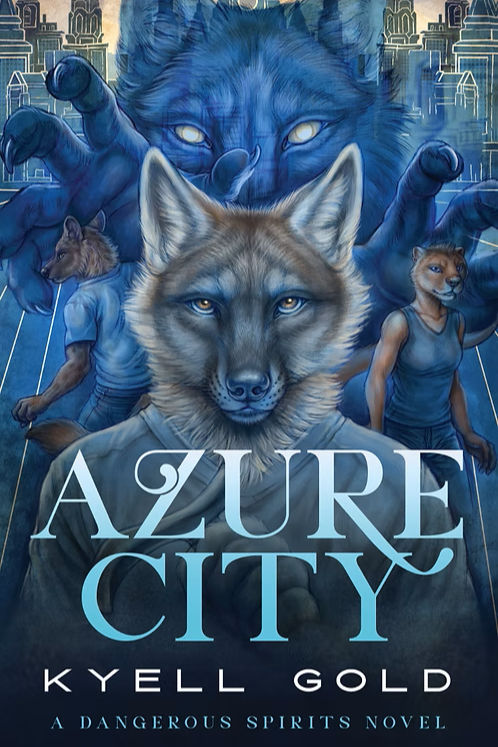
And of course, I can't close out this review without mentioning Rukis's return to illustrate the book. The cover is probably my favorite in the series, and the interior illustrations are some of her best. I'll no doubt be picking up a few prints of these illustrations at a convention sometime.
So, I think Azure City is a great addition to the lineup of Dangerous Spirits books. Yes, it has a more linear format, but it still follows, evolves, and inverts the thematic traditions of the original trilogy, while upping the mysterious vibes and maturing a few of the characters. I think some readers will be disappointed by the format change. That's unavoidable. But I personally enjoyed the book for what it was, and I look forward to seeing if any future Dangerous Spirits books will be written in this same style.


Wow! You definitely have my attention from what you’ve described so far and I am extraordinarily intrigued by the plot of this new Dangerous Spirits novel. Seeing this really takes me back to when I first read the trilogy ten years ago :)